- Residence permission, crypto tax and bank acceptance are separate decisions.
- Classify holdings, trading, rewards and work income before applying any tax relief.
- Keep provider-level records and a euro cash runway; exemptions do not eliminate reporting.
Portugal’s 365-day rule can exclude qualifying personal disposal gains. It is not a blanket exemption for every token, income stream or business. The tax authority’s crypto tax overview explains the distinction; the current Code is linked below.
What moving to Portugal with crypto actually requires
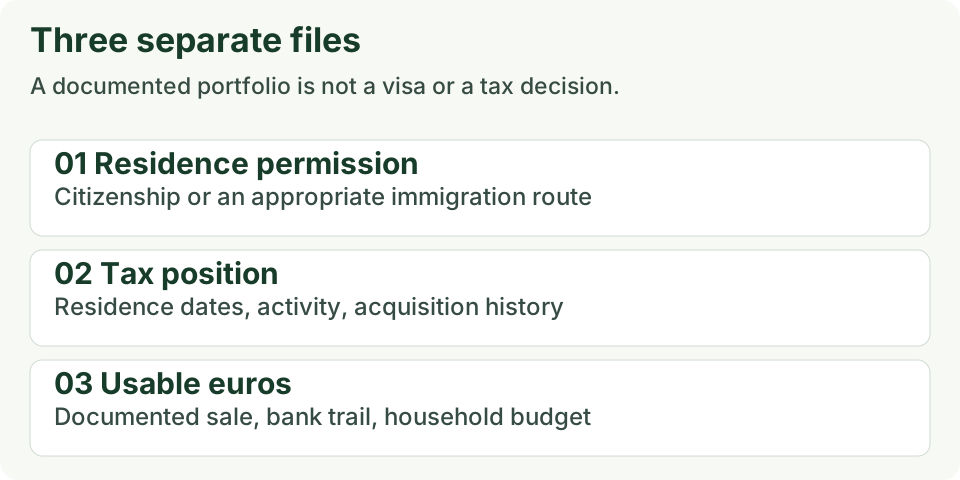
Build three files, rather than one screenshot of your portfolio:
- Residence: the citizenship right or immigration route you will use, supported by the evidence that route requires.
- Tax: acquisition records, your actual activity and a timeline connecting your old country with Portugal.
- Spending money: a documented conversion and banking route, plus a household budget in euros.
A large portfolio answers “what do you own?” It does not, by itself, answer “what income will the consulate accept?” or “what money can you reliably spend next month?”
If you already know the move is feasible and only need the tax mechanics, use our Portugal crypto tax guide: holding periods, swaps and records.
Why your crypto activity changes the plan
“I work in crypto” can describe very different situations. Start with the row that describes what you actually do.
| Your situation | The question to resolve before moving |
|---|---|
| You hold personal investments and occasionally sell | Which assets and disposals qualify for personal-gains treatment? |
| You trade actively to fund your household | Does your activity remain personal investing, or require a business/professional analysis? |
| You receive salary or client fees in tokens | How is the underlying work income classified, valued and reported? |
| You earn staking, lending or other rewards | What arrangement produces the return, and which income and timing rules apply? |
| You provide crypto services to clients | What business, immigration and regulatory permissions are needed? |
Do not rely on an invented “trades per year” safe harbour. Give the adviser your actual transaction history, contracts and operating arrangements, not just your preferred label.
Portugal’s tax authority distinguishes business/professional income, investment income and capital gains in its official crypto tax leaflet. Mining and transaction validation also appear expressly in CIRS Article 4.
Rewards need particular care: Article 5 has a specific disposal-time rule for certain remuneration received as cryptoassets. Neither “all staking is immediately taxable” nor “all rewards are tax-free” is a safe universal shortcut.
For qualifying Category B activity within the simplified regime, Article 31(1)(a) and (d) use coefficients of 0.15 for relevant crypto operations and 0.95 for mining. These determine the income brought into the tax calculation; they are not 15% and 95% tax rates, nor a way to elect business treatment for every personal sale.
Check registration, accounting and any social-security contributions separately. Coverage, exemptions and the facts of the activity matter; do not assign every crypto holder an automatic contribution bill. The official self-employed social-security guidance is the starting point.
How to move to Portugal with crypto, step by step
1. Choose the residence route before relying on your portfolio
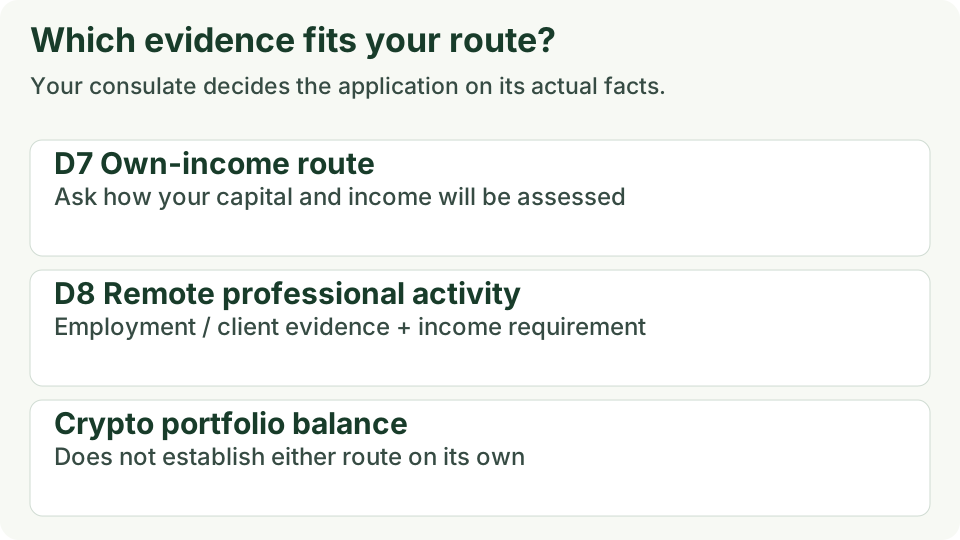
EU citizens: start with free-movement registration, not a D7 or D8 application. AIMA says the registration certificate is required for stays exceeding three months; check its EU-national registration guidance for the applicable conditions.
People living on their own income: Portugal has a residence-visa route commonly called D7. The government’s own-income visa page does not promise acceptance of crypto balances or trading profits.
Ask the consulate responsible for your application how it will assess your particular evidence. Explain whether you are drawing down capital, receiving investment income or actively earning. Do not assume these are interchangeable.
Remote employees and independent professionals: the route commonly called D8 concerns qualifying work performed remotely for entities outside Portugal. AIMA’s remote-work residence guidance requires evidence of that employment or service relationship. Trading your own portfolio is not evidence of such a relationship.
Article 31-A of the visa regulation requires evidence of average monthly income from the qualifying professional activity over the previous three months equal to at least four guaranteed minimum monthly wages. Using the €920 minimum for 2026, that is €3,680 per month. It is not a wallet-balance test; household and application requirements still need checking.
For the document sequence, see our Portugal D8 application guide. Use the competent consulate’s current checklist for income thresholds, fees, insurance and family additions—not a crypto promoter’s approval promise.
2. Map tax residence before choosing a sale date
Portugal’s residence test is not simply “stay fewer than 183 days.” Article 16 includes both more than 183 days in a relevant 12-month period and a habitual-home test that can apply with fewer days. Residence can run from the first day of the relevant stay, subject to the statutory rules.
Residents generally fall within Portuguese IRS on worldwide income under Article 15. Leaving an exchange or bank account abroad does not, on its own, remove that issue.
Before a material sale, ask for a written timeline covering:
- When your old country stops treating you as resident, and what obligations remain.
- When Portuguese residence starts, including the effect of the home you occupy.
- Which country or countries can tax the planned transaction.
- Whether a treaty, departure provision or continuing filing duty changes the result.
For US citizens and resident aliens, moving abroad generally does not end US worldwide-income obligations. The IRS guidance for Americans abroad should be part of that review.
3. Check the tax treatment—not just the holding period
For qualifying personal disposals held at least 365 days, Article 10(22) excludes gains and losses. Securities and unique, non-fungible assets need separate analysis. Article 10(23) provides qualifying crypto-to-crypto carryover treatment; retain the earlier acquisition history rather than treating a swap as permission to discard it. See the current CIRS Article 10.
For personal gains that are not excluded, Article 72 provides a 28% autonomous-rate framework. That is not necessarily your final effective rate: classification, aggregation rules and your other facts still matter.
The current Article 10(24) still displays older internal cross-references after the May 2026 renumbering. Have a qualified adviser reconcile the operative text and your transaction before claiming relief; do not infer that the condition disappeared or assume every offshore exchange automatically defeats it.
For passive rewards, Article 5(11) establishes disposal-time treatment when the relevant remuneration takes the form of cryptoassets. It does not itself state a universal €0 acquisition basis. Do not assume a reward’s market value on receipt is automatically deductible; establish its basis and treatment from the actual arrangement. Token wages, professional validation and passive rewards are not interchangeable.
Do not build the move around automatic access to old NHR marketing claims. IFICI is a separate, activity-dependent incentive—not a status conferred by owning crypto. Its eligibility framework is in EBF Article 58-A.
Exempt gains can still need a tax return
The standard online Modelo 3 filing window is 1 April–30 June, generally for the previous year, subject to special rules. See CIRS Article 60.
- Anexo G1: the official instructions include qualifying 365-day crypto disposals. An exclusion from tax is not permission to omit the transaction.
- Anexo G / J: taxable disposals need the appropriate reporting. Anexo J concerns foreign-source income; using a foreign exchange alone is not a complete source-of-income analysis. Use the instructions for the relevant tax year.
- FIFO records: Article 43(8)(g) and (9) prescribe oldest-acquired-first treatment, applied per relevant institution/provider where assets are deposited with several. Reconcile transfers and history rather than resetting dates when moving platforms.
Provider reporting does not replace your return
CIRS Article 124-A sets a 31 May deadline for in-scope providers to report the previous calendar year. Under Lei 26/2026, Annex III, Article 2, the first relevant year is 2026, making the corresponding annual provider deadline 31 May 2027. This is a provider obligation—not your Modelo 3 deadline and not a guarantee that every platform worldwide reports identically.
Keep your tax residence and identification details accurate with providers. Do not assume their data will file your return or correctly classify every transfer for you.
4. Prepare the bank file before making a large transfer
Banco de Portugal’s account-opening guidance explains identification and supporting-document requirements. Our Portugal NIF and bank-account guide covers the practical setup questions.
For crypto-derived funds, prepare a source trail you can explain:
- The original source of the money used to acquire the assets.
- Purchase records, dates, quantities and fees.
- Exchange statements and links between wallets you control.
- Records distinguishing purchases from salary, rewards and transfers.
- The sale confirmation and the complete payment route into your bank account.
This is a preparation checklist, not a promise that every bank requires the same documents or will accept your transfer. Ask the chosen institution about your actual exchange, amounts and evidence before setting a property-payment deadline.
5. Check exchange access and keep spending reserves separate
Ask each provider what changes when your residence becomes Portugal: the contracting entity, supported assets, account verification, withdrawal route and records you can export.
This matters particularly for stablecoins. ESMA’s October 2026 supervisory statement says MiCA-authorised providers should cease services involving non-compliant stablecoins. Do not assume your current trading pairs and withdrawal options will remain available.
For household planning, distinguish euros already available for bills from stablecoins, locked tokens and an unrealised portfolio valuation. EU supervisors warn that crypto can be risky and protection may be limited; see their consumer warning.
If you intend to serve clients rather than invest your own money, get a separate regulatory review. MiCA Article 59 governs authorisation to provide cryptoasset services. A residence permission is not that authorisation.
A crypto-funded relocation budget: worked example
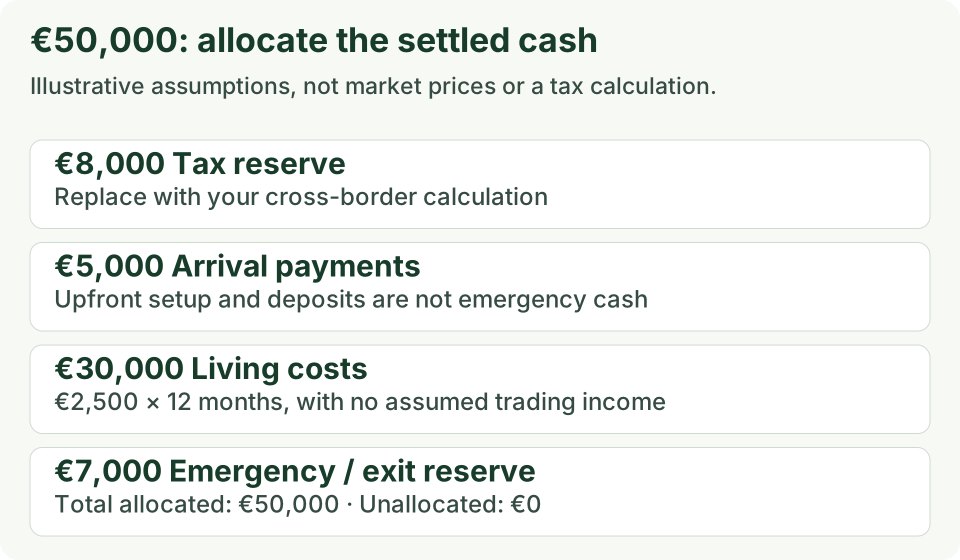
Illustration only—not a tax calculation, visa requirement, provider quote or cost-of-living average.
Suppose you have €50,000 in settled bank cash, after conversion and transfer charges but before any tax on the sale. Assume no further trading profits or other income during the year.
| Allocation | Illustrative amount and period |
|---|---|
| Tax reserve pending a calculation | €8,000 reserved once |
| Arrival payments, including deposits and setup | €5,000 upfront |
| Household living costs | €2,500 per month × 12 = €30,000 |
| Emergency/exit reserve, not ordinary spending | €7,000 kept aside |
| Total allocated | €50,000 |
| Unallocated cash | €0 |
The €8,000 is an assumed reserve, not an implied tax rate. Replace it with the actual cross-border calculation. The monthly allowance includes the assumed recurring housing, food, utilities, transport and health costs; do not add those same bills a second time.
Refundable deposits are still unavailable while someone else holds them. If your actual arrival costs, continuing bills abroad or tax reserve are higher, this plan needs more cash or lower spending. Future token appreciation does not close the gap.
Use the relocation budget planner for household costs. Enter confirmed available income and cash assumptions; it is not a crypto tax engine or a visa assessment.
Moving your own assets is different from giving them away
A transfer between wallets you own is not the same economic event as a gift to another person. Crypto gifts can enter Portugal’s 10% Stamp Duty framework where the territorial rules apply. Exemptions include qualifying transfers to spouses/de facto partners, descendants and ascendants—not every relative. Check CIS Article 4, Article 6 and the AT crypto tax explanation before gifting assets as part of a move.
Before you commit to the move
- Get the residence route and required evidence checked before signing a long lease.
- Resolve the arrival-year tax timeline before a large sale or change of activity.
- Export records before changing accounts or losing access to an exchange.
- Obtain the bank’s instructions before sending property or relocation funds.
- Budget healthcare, housing deposits, professional fees and a possible return home.
- Agree who will prepare the returns and what documents they need.
For housing decisions, continue with renting in Portugal or buying property in Portugal. Keep the housing commitment separate from assumptions about a future crypto sale.
Frequently asked questions
Can I get a Portugal D7 visa with Bitcoin or crypto savings?
Do not assume so. The official own-income route does not guarantee that a particular crypto portfolio or trading history satisfies its evidence requirements. Explain your capital and income sources to the responsible consulate and obtain its current instructions before committing money.
Is Portugal still tax-free for crypto holders?
Not universally. The personal holding-period exclusion is conditional, while work, yield and business activity need their own treatment. For detailed examples, read the Portugal crypto tax guide.
Must I live in Portugal for 365 days before selling?
The crypto provision concerns the asset’s holding period, not a requirement to spend 365 days in Portugal. Establish the relevant acquisition history and your tax residence separately; neither test replaces the other. See Article 10.
Does a crypto swap or no bank withdrawal mean there is nothing to check?
No. Swap treatment, rewards and professional receipts need classification and records. Article 5 and the crypto provisions in Article 10 should be read together where applicable. A withdrawal statement alone is not a complete tax ledger.
Can an active trader use the digital nomad route?
Do not equate trading your own capital with a qualifying overseas employment or client relationship. Have the immigration professional assess what you actually do and identify the appropriate route; the tax classification is a separate decision.
What happens if I leave Portugal with crypto later?
Article 10 treats loss of Portuguese tax residence as a disposal for the relevant crypto provision. Review the consequences before departure rather than assuming tax can arise only after an exchange sale.
Do I report crypto sales even if no Portuguese tax is due?
Qualifying long-held disposals are covered by the Anexo G1 instructions. Confirm the correct annex and tax-year form for your facts. Exchange reporting is separate and does not replace your personal return.
Does staking always give me a €0 tax basis?
Do not treat that as a universal conclusion from Article 5(11). It specifies timing for the relevant token remuneration; the arrangement, tax category and acquisition-value analysis still need checking. Keep rewards separate from purchased holdings and token compensation for work.
Learn More
Source review: the tax, reporting and residence distinctions described here were checked against the linked official sources on . Reconfirm current rules and your facts before acting.
Prepared with AI assistance using the sources below. How we work →
General education, not personal tax, immigration, investment or legal advice. The AT leaflet and some form instructions retain older paragraph numbering; consult the current Code. No individual application, bank transfer or tax return has been approved by this guide.
- crypto tax overview
- CIRS Article 4
- Article 5
- Article 31(1)(a) and (d)
- official self-employed social-security guidance
- EU-national registration guidance
- government’s own-income visa page
- remote-work residence guidance
- Article 31-A of the visa regulation
- €920 minimum for 2026
- Article 16
- Article 15
- IRS guidance for Americans abroad
- current CIRS Article 10
- Article 72
- published ruling 28122, paragraph 9
- EBF Article 58-A
- CIRS Article 60
- official instructions
- Anexo J
- Article 43(8)(g) and (9)
- CIRS Article 124-A
- Lei 26/2026, Annex III, Article 2
- Banco de Portugal’s account-opening guidance
- October 2026 supervisory statement
- consumer warning
- MiCA Article 59
- CIS Article 4
- Article 6